CHICAGO HOUSE MUSIC FESTIVAL 2026

House music has traveled far beyond Chicago since it emerged from the city’s club culture more than four decades ago. But once a year, the Chicago House Music Festival brings that history back into public space — not simply to remember where the music came from, but to show what has survived, evolved and grown around it.
The 2026 Chicago House Music Festival & Conference, produced by the Chicago Department of Cultural Affairs and Special Events, unfolded August 27–30 as a free four-day program stretching from Daley Plaza and the Chicago Cultural Center to Grant Park, Millennium Park and the Chicago Riverwalk. More than 40 DJs and artists participated alongside dancers, educators and other members of Chicago’s house community.
That breadth matters because Chicago house was never only a collection of records or a handful of famous DJs. It developed through overlapping club, DJ and social-dance communities — particularly Black, Latino and LGBTQ+ spaces — where music, dancing and the room itself were inseparable. The Warehouse and Frankie Knuckles remain central to that history, but Chicago’s house story also moved through dancers, promoters, neighborhood parties, radio, record stores and generations of clubs that followed.
The 2026 festival reflected that larger history surprisingly well. It started with conversation and education, moved onto an open public dance floor, exploded across four areas of Millennium Park on Saturday, then came down gently beside the river on Sunday.
Thursday established what kind of weekend this was going to be.
The afternoon began with DJs Nosha Luv, Cratebug and Martin Boogieman Luna at Daley Plaza before programming moved into the Chicago Cultural Center for the House Music Conference and House Dance Summit.
There, the subject was not merely house music history. Panels addressed problems that working artists are dealing with now: publishing and royalties, independent distribution, physical media, visibility, artificial intelligence, relationships between DJs and venues, and how knowledge moves from one generation of Chicago artists to another. The evening culminated in a keynote conversation with Jamie Principle moderated by Steve “Silk” Hurley and Shannon “Skip” Syas.
Principle’s appearance carried unusual weight in 2026. Only months earlier, his seminal “Your Love,” together with the later Frankie Knuckles version, had been selected for the Library of Congress National Recording Registry — federal recognition for a piece of music that began inside Chicago’s early house ecosystem. Louie Gomez, who was involved in mixing the 1986 release, would appear on the Pavilion stage two days later.
Dance was receiving the same attention. BraveSoul Movement led an all-ages lesson; panels examined the roots and branches of Chicago house dance; and the BODY: House Dance Competition began its qualifying rounds.
Thursday, in other words, treated house as something people have to preserve, teach, work in and pass on — not simply celebrate.
Friday continued the dance programming inside the Cultural Center before the festival moved outside to the Spirit of Music Garden in Grant Park for Chicago SummerDance.
And that move changed the character of the weekend.
BraveSoul Movement opened the evening with a community house-dance workshop before Ron Troupe and Mark “Flava” Fuller took over the music. Founded in 2016 by Daniel “BRAVEMONK” Haywood and Kelsa “K-Soul” Rieger-Haywood, BraveSoul works across house and hip-hop culture with an emphasis on movement, musicality and community. Its presence throughout the weekend — teaching Thursday and Friday and with BRAVEMONK involved again during Saturday’s BODY finals — made the group one of the threads connecting the festival’s educational and performance sides.
Ron Troupe also represents another important strand of Chicago house history: radio. Troupe traces his path into DJing to the early 1980s and the influence of WBMX’s Hot Mix 5, part of the radio culture that helped dance music escape the walls of individual clubs and reach listeners throughout the city.
But Friday did not feel like a history lesson.
People were learning steps, dancing in groups, watching one another and then joining in. Contemporary photo coverage from the evening similarly documented a crowd participating rather than standing passively in front of a stage.
That distinction would become even more important the next day.
Friday at Spirit of Music Garden


FRIDAY GALLERY

Saturday was the center of the festival — eight hours of simultaneous programming spread across four areas of Millennium Park.
By Saturday afternoon, Millennium Park was packed, with crowds moving among four simultaneous festival areas.
The Jay Pritzker Pavilion carried a historically weighted lineup. The North Promenade spent its first hours on footwork and house dance before becoming the Soulful House Stage. The South Promenade became the Chicago House Stage. And the Groove Garden ran throughout the day at Millennium Hall’s Double Clutch Beer Garden.
The four areas weren’t simply successive stops on a schedule. They operated at the same time.
That made Saturday less like one concert with supporting attractions and more like several versions of Chicago dance culture happening alongside one another.

The Jay Pritzker Pavilion lineup made the history of Chicago house audible without needing to turn the stage into a museum.
Eric “ET” Taylor and Chip E. connect directly to the early studio culture surrounding records such as “Time to Jack.” Louie Gomez connects the afternoon to Jamie Principle’s “Your Love.” Sundance opens another branch entirely through hip house, the late-1980s Chicago meeting point between house production and rap.
Then the lineage extends outward.
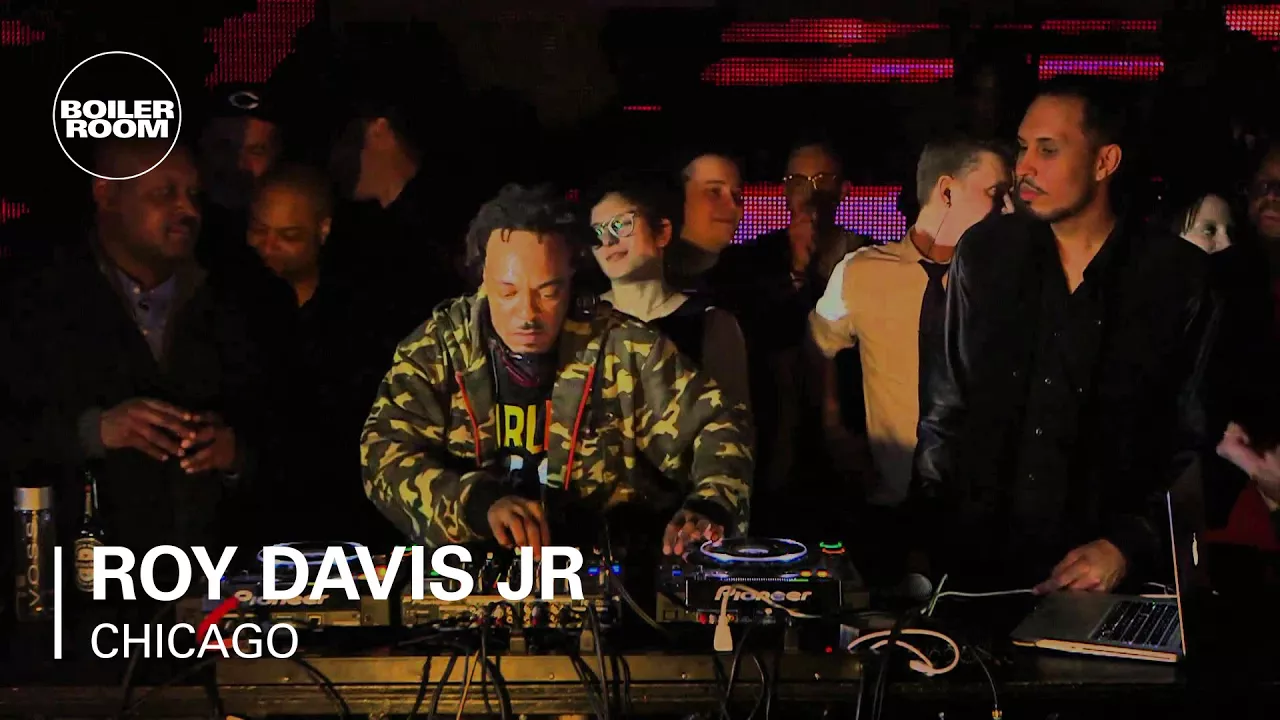
Roy Davis Jr.’s 1996 “Gabriel,” featuring Peven Everett, became influential far beyond Chicago and is closely associated with the development of UK garage. Maurice Joshua’s career traveled in another direction, from Chicago house production into major-label remix work, eventually earning a Grammy for his remix of Beyoncé’s “Crazy in Love.”
The significance of the Pavilion lineup therefore wasn’t that every artist belonged to exactly the same era or sound. It was almost the opposite.
Early jack records, disco and rare groove, hip house, soulful production, international influence and mainstream remix culture could all be traced back through artists sharing one stage.
House history looked less like a straight line than a family tree.
Jay Pritzker Pavilion


JAY PRITZKER PAVILION GALLERY

If the Pavilion told the story through records and DJs, the North Promenade told it through bodies in motion.
Its Saturday program began with youth footwork activities and a Footwork Appreciation Month workshop, followed by a multigenerational showcase. At 2:30 p.m., the space became the floor for the BODY: House Dance Competition Finals, presented by Jus.Be House Collective, before the House Dance Summit awards ceremony. Only after that did the area transform into the Soulful House Stage.
That scheduling choice is important.
Dance wasn’t placed between DJ sets as entertainment. It occupied the first three hours of an entire major festival area.
And the festival did not treat house dance and Chicago footwork as interchangeable. They have distinct histories and movement vocabularies: house dance developed through club and house-music culture, while Chicago footwork grew around its own battle traditions and faster juke and footwork music. Saturday placed those forms beside one another instead of collapsing them into one.
At 4 p.m., the same space became the Soulful House Stage, where Yanna Lynette, DJ Double XX, Mickey Calvin, Emmaculate and K’Alexi Shelby carried the program into the evening.
The final two names alone show how wide that term could stretch. Emmaculate represents contemporary Chicago production and remix culture, while K’Alexi Shelby reaches back into the city’s early acid-house history and its connection with Detroit techno through labels including Derrick May’s Transmat.
The space changed function, but the underlying idea remained remarkably consistent: house culture is something learned from other people, tested against other people and ultimately shared with them.
North Promenade / House Dance Summit


HOUSE DANCE 4


NORTH PROMENADE GALLERY

The Chicago House Stage on the South Promenade offered perhaps the broadest portrait of the city’s working DJ ecosystem.
Karl Almaria, Jukeman DJ Puncho, DJ Nehpets, DJ Flipside, DJ Jes, Michael Serafini, Diz and DJ Heather filled the eight-hour schedule.
The interesting part of that lineup is how differently its artists connect to Chicago dance music.
DJ Nehpets provides a bridge toward Chicago juke. Flipside’s career passes through turntablism, B96 mix radio and production. Diz connects to the deep and funky underground of clubs such as Shelter, Red Dog and Boom Boom Room. Michael Serafini represents something equally important but easier to overlook: the infrastructure that keeps a scene alive. As owner of Gramaphone Records and a longtime figure behind smartbar’s Queen!, his history joins record retail, DJ culture and queer nightlife.
And DJ Heather, who closed the stage, carries another history. Her work with Superjane alongside Colette, Lady D and Dayhota helped make women DJs more visible within Chicago house without treating their presence behind the decks as a novelty. Her role in the 2026 festival also extended beyond performing: two days earlier, Heather had moderated a conference discussion about DJ advocacy and relationships with venues.
Taken together, this wasn’t really a stage devoted to one narrowly defined version of Chicago house.
It was a snapshot of how a local scene survives — DJs, producers, clubs, radio, record shops and nightlife communities continually feeding into one another.
Chicago House Stage


CHICAGO HOUSE STAGE GALLERY

At Millennium Hall’s Double Clutch Beer Garden, the Groove Garden Stage ran its own full eight-DJ program: Melvin Meeks, Wes Green, Milty Evans, Chris Lara, J.Star, Jillian X, Aaron Antoniou and Pablo Punkout Gonzalez, with LoveBug hosting.
Compared with the Pavilion, the setting was physically smaller and more informal — but that was part of what made having four simultaneous areas interesting.
A festival built around a culture that grew in intimate social spaces did not have to exist at one scale.
Here, performers and listeners shared a tighter footprint than at the Pavilion, providing a counterpoint to Millennium Park’s largest stage while giving another group of Chicago DJs their own uninterrupted program.
Rather than representing a single subgenre, Groove Garden offered a looser, more intimate side of the festival. Local DJs, dancers, and longtime house fans filled the space, turning it into a smaller-scale reflection of the larger celebration, social, open, and unmistakably rooted in Chicago’s house community.
Groove Garden


GROOVE GARDEN GALLERY

With so many DJs on the schedule, it would be easy to photograph Saturday as a sequence of people standing behind equipment.
That would miss half the festival.
House music began as social music, in rooms where the relationship among DJ, sound system, records and dancers mattered as much as any single track. That history is one reason the heavy emphasis on dancing throughout the 2026 festival felt less like additional programming and more like a continuation of the culture itself.
This is also where the photographs can tell what schedules and artist biographies cannot: the circles that formed, the people watching from the edges before stepping in, the encounters between performers and listeners, and the different ways four spaces inside one park developed their own character.
The festival supplied the lineup.
The crowd made it a dance floor.


Sunday shifted the festival into a different kind of Chicago setting.
Wind Down: House on the Riverwalk brought Sandra Suave, El Caveman, Lee Farmer and Mark Grant to The Confluence at the west end of the Chicago Riverwalk, where the river’s branches meet. With bridges, passing boats and downtown buildings surrounding the crowd, the setting gave the final day a character entirely its own.
The lineup remained firmly connected to Chicago house history. Mark Grant’s long association with the Cajual and Guidance era places him within the deep-house generation that carried the city’s sound through the 1990s and beyond.
Rather than simply winding the festival down, Sunday showed how naturally house could inhabit another piece of the city.
House on the Riverwalk


HOUSE ON THE RIVERWALK GALLERY

Chicago’s relationship with house music has changed dramatically.
A culture that developed in nightlife spaces created largely by marginalized communities is now celebrated inside some of the city’s most visible civic spaces. The former Warehouse building at 206 S. Jefferson St. became a Chicago landmark in 2023. A nearby stretch of Jefferson has carried the honorary name Frankie Knuckles Way since 2004. And Chicago’s city government has increasingly described house not simply as entertainment, but as part of the city’s cultural heritage.
The city-sponsored festival itself has evolved along the same path. Its current lineage reaches back to the Chicago House Party at Millennium Park in 2016; by 2018 it was operating under the Chicago House Music Festival name with multiple stages, conference programming and dance. The current four-day format developed over time rather than appearing suddenly in 2026.
And perhaps that is what made the 2026 edition work.
It respected the people who built the culture without presenting house as something that had already finished happening.
There were pioneers and decades-deep DJs. But there were also working producers, record-store owners, dancers, educators, young people learning footwork, competitors entering circles, and crowds simply showing up in a public park and dancing.
Forty-plus years after Chicago gave house music to the world, the most convincing tribute may be the simplest one.
The city is still dancing.

This article was informed by the Editorial Research Dossier: Chicago House Music Festival & Conference 2026 and the following official, institutional and specialist sources: